 Skip to content

Shipping a vintage car isn’t like shipping a Honda Civic. The quote you get depends on a dozen moving pieces, and if you don’t know what’s driving the number, you can’t push back on it or plan your budget properly. Here are the 10 factors that shape classic car transport cost, plus operational examples so you know what to expect before you book.
1. Dispatch Dudes (Our Top Pick) , Fully Insured Classic Car Shipping Nationwide
We’ll be straightforward: this article lives on our blog, and we’re Dispatch Dudes, a nationwide vehicle transport company based in Boynton Beach, FL. We ship cars, motorcycles, and boats across the US using open and enclosed trailers with fully insured carriers. We’re BBB accredited, recognized by Forbes Business Council, and named a Newsweek Readers’ Choice company.
For classic car owners specifically, we offer enclosed transport, door-to-door pickup and delivery, and expedited service. Our dedicated advisors work one-on-one with you to match the right carrier to your vehicle’s dimensions, value, and timeline.
One thing we’ve found in this industry: most shippers don’t publish cost ranges, minimum charges, or enclosed-vehicle surcharges anywhere on their websites. That’s true of us and most competitors. Pricing for classic cars is always custom, because each shipment is unique. A 1932 Packard hauled from Chicago to Miami on a climate-controlled trailer costs very differently from a 1967 Mustang moved 400 miles on a standard enclosed carrier.
What that means for you: the quote is your primary decision point. Get it, compare it, and look hard at what’s included, not just the total number. For a full breakdown of what’s covered when you book with us, compare our classic car shipping options, costs, and what each service level includes.
The rest of this article walks through every factor that moves your quote up or down, so you can show up to that conversation informed.
2. Enclosed Transport vs. Open Transport , The Biggest Cost Divide
This is the single biggest lever on your bill. Open transport is how roughly 95% of everyday vehicles move across the country. Cars ride on an exposed multi-car hauler, visible to the weather and road debris the entire trip. For a daily driver, that’s fine. For a classic car with original paint, chrome trim, or irreplaceable bodywork, it’s a real risk.
Enclosed transport loads your vehicle inside a sealed trailer, protected from rain, road grit, UV exposure, and flying stones. Enclosed shipping typically runs 50 to 100 percent more than open transport for the same route, with the premium varying based on distance and route, and climbing significantly for coast-to-coast shipments.
Open transport is cheaper per mile. But for any vehicle where a small scratch could cost thousands to repair or reduce resale value, the math shifts quickly in favor of enclosed.
There’s also a usable point that experienced haulers mention often: enclosed trailers are specifically built to handle low-profile cars. Open carrier ramps are steep, and getting a vehicle with two inches of ground clearance onto one is a gamble. Enclosed trailers use shallower ramps or hydraulic liftgates, which makes the whole loading process safer for the car.
3. Shipping Distance , How Mileage Shifts Your Rate
Distance is the biggest single variable in any auto transport quote, but it doesn’t scale linearly. The more miles you add, the lower your cost per mile gets. That’s because carriers have fixed costs tied to loading, unloading, paperwork, and insurance that get spread over a longer run. Per-mile rates are higher on short hauls and decrease as the total distance grows, even though the total bill is higher.
Pricing varies depending on route, trailer type, and current carrier availability. Short hauls and long cross-country moves each carry different rate structures, so getting a direct quote is the most reliable way to understand what your specific move will cost.
For enclosed classic car transport, expect to pay more on top of open-carrier benchmarks. Pricing varies by distance, vehicle size, and route demand, so rates are available on request.
Route popularity also matters. A well-traveled corridor like Los Angeles to Chicago has a lot of carriers running that lane regularly, which keeps pricing competitive. A move between two rural towns adds difficulty for carriers to fill a trailer efficiently, and that cost flows back to you.
One more thing: if your timeline is flexible, you’ll almost always get a better rate. Locking a carrier into a specific pickup day means they may have to reroute or hold a spot open. Give them a 3 to 5 day pickup window and the quote often comes down.
4. Vehicle Size and Weight , Oversized Classics Cost More to Move
A carrier’s trailer has a finite amount of space and a legal weight limit. Every extra inch and pound your car adds reduces the number of other vehicles that can ride along, so the carrier passes some of that cost to you.
The difference is meaningful. Shipping a standard-sized vehicle like a compact sports car costs noticeably less than shipping a full-size American muscle car or a large vintage luxury sedan. Larger vehicles add a noticeable premium to the base shipping cost compared to a standard sedan, and the exact amount varies by route and carrier.
Think about the gap between a 1965 Triumph TR4 and a 1964 Lincoln Continental. The Triumph is around 160 inches long and weighs under 2,000 pounds. The Lincoln stretches to 220 or 230 inches and is significantly heavier. On an enclosed trailer, the Lincoln takes up the space of nearly two smaller cars. That size difference shows up directly in the quote.
Weight also affects fuel economy. Fully loaded car carriers get around 5 to 8 miles per gallon of diesel. A heavier vehicle pushes that number down, and carriers factor fuel costs into their pricing dynamically. When diesel prices rise, heavier vehicles see a proportionally larger impact on their quotes.
If your classic has aftermarket modifications, a widened body, a lifted suspension, or a custom roof, disclose that upfront. Non-standard dimensions can require special tie-down equipment or a different trailer configuration, both of which add cost. Hiding those details and surprising the driver at pickup is one of the fastest ways to get hit with an unexpected fee.
5. Unique Dimensions and Loading Challenges , Fender Overhang and Low Clearance
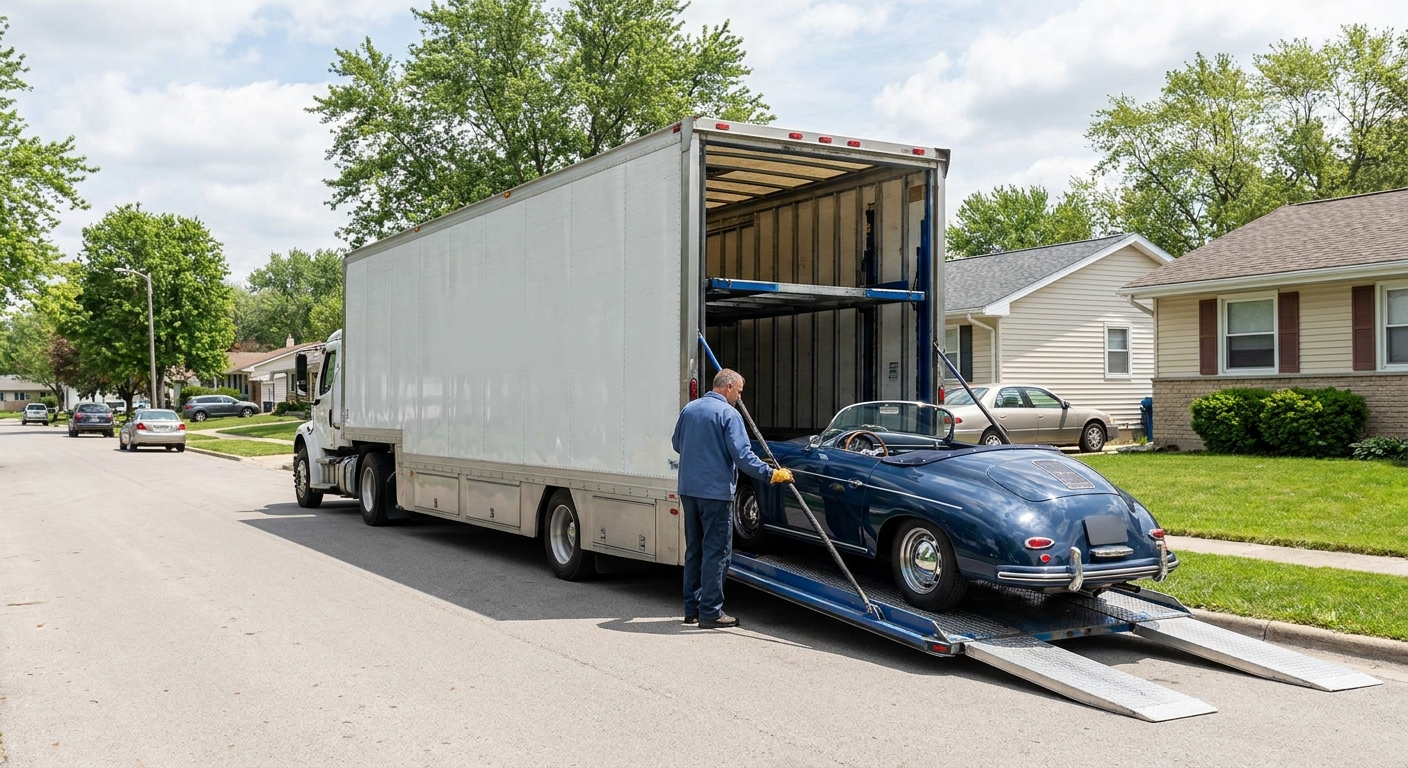
This is a factor almost no one talks about until it causes a problem. Pre-war American classics, for example, have fenders that extend well past the tires on both sides. An enclosed trailer is typically 81 inches wide from fender to fender on the inside. When a driver tries to pull a 1937 Cadillac into that space, they can’t see where the tire actually is because the bodywork hides it completely.
Loading a wide-body classic into an enclosed trailer solo creates real risk of damage. A spotter walking alongside or a remote winch to pull the vehicle in safely is the right approach. Without that, the steering play in old cars makes it very easy to drift a fender into the trailer wall.
Low clearance is an equally serious issue. Pre-war and modified cars sometimes sit just a few inches off the ground. Standard loading ramps , especially on open carriers , have a steep angle that would scrape the nose or rocker panels. Enclosed carriers built for collector vehicles use hydraulic liftgates or shallow-angle race ramps specifically to handle this. If a carrier doesn’t have that equipment, they shouldn’t be loading your car.
Skinny tires on very old cars present another challenge. A narrow tire can slide right off the edge of a loading ramp if the driver misjudges by even a few inches. Wide modern tires are forgiving; a 1920s-era tread width is not.
When you’re getting quotes, ask directly: does the carrier have a liftgate or race ramps? Do they use a spotter for wide-body classics? The answers tell you a lot about whether they’ve actually moved cars like yours before. This is exactly the kind of equipment question our dedicated advisors at Dispatch Dudes ask on your behalf when matching your vehicle to the right carrier.
6. Pickup and Delivery Location , Door-to-Door vs. Terminal
Where your car gets picked up and dropped off affects the quote in two ways: the type of service you choose (door-to-door vs. terminal) and the accessibility of your location.
Door-to-door service means the carrier comes to your home or business and delivers to the destination address. It’s the most convenient option and the one most classic car owners prefer, because it eliminates unnecessary handling and means the car never sits unsupervised at a storage lot. It does cost more than terminal service because of the extra routing involved.
Terminal-to-terminal service has you drop the car at a designated depot and pick it up from another depot at the destination. The savings are real, but the tradeoff is added risk. Your car sits at a shared facility with other vehicles. For a valuable classic, that exposure is worth thinking hard about before choosing it to save a little money.
Location accessibility is a separate issue. A car carrier is a large truck, sometimes up to 80 feet long. If you live on a narrow street, in a gated community, or in a dense urban neighborhood, the truck physically may not reach your driveway. In those cases, the driver will meet you at a nearby parking lot or wide intersection. That’s standard, not a service failure, and it doesn’t add to your cost.
Rural pickup and delivery locations do add cost. A carrier coming to a remote property may need to drive an hour off their standard route. That extra time and fuel shows up in your quote. Metro areas with high transport volume tend to have better pricing because carriers can fill trailers more efficiently on established routes.
7. Seasonality and Weather , Why Winter Moves Cost More
Auto transport pricing is seasonal. Demand drives rates up, and two factors drive demand: migration patterns and weather conditions.
Spring and summer are peak seasons for classic car transport. Car shows, auctions, and favorable driving weather all generate more shipments at once. Carriers get busy, open slots fill quickly, and prices climb. Snowbird season adds another surge in fall and spring, as owners move vehicles between northern and southern states.
Winter creates a different problem. Routes through areas with heavy snow, ice, or severe weather become harder to run safely. Carriers slow down, sometimes pull over to wait out conditions, and take longer to complete runs. Fewer trucks are willing to take on difficult winter routes, so the ones that do can charge more. For popular snowbird corridors like the Northeast to Florida run, early bookers in September often get better rates than those waiting until November when every truck is full.
Weather also matters for the car itself. Open transport in winter exposes your classic to road salt, which is particularly damaging to original undercarriages and chrome. If you can’t avoid a winter shipment, that’s another argument for enclosed transport, not just for the cost savings but for the physical protection.
If your schedule is flexible, booking during slower months , late fall or mid-winter on non-weather-affected routes , can meaningfully reduce what you pay. Booking at least two to four weeks ahead also helps, regardless of season. Last-minute requests during peak periods often come with a significant premium.
8. Insurance and Declared Value , Protecting a High-Value Car in Transit
Every licensed interstate carrier must carry cargo insurance. That’s a federal requirement under federal law. But coverage limits vary widely, and for a high-value classic, the carrier’s standard policy may not come close to covering what your car is worth.
Cargo coverage limits vary by trailer type and carrier. That matters because rare classics regularly sell for six figures, and some reach into the millions. A 1955 Mercedes 300SL Gullwing recently sold at auction for over $6.8 million. Even a well-restored 1969 Dodge Charger commands significant value in today’s market.
Before you book, ask the carrier for their Certificate of Insurance. Confirm it’s active, check the coverage limit, and find out who pays the deductible if there’s a claim. Some policies have the customer pay the deductible, which can be thousands of dollars. That detail is easy to miss in the fine print.
If the car’s value exceeds the carrier’s coverage limit, you have options. Some carriers offer supplemental declared-value coverage. You can also check whether your personal auto insurance or a specialty collector car policy covers vehicles in transit. Many do, but as secondary coverage, meaning the carrier’s policy pays first. Understand the order of coverage before something goes wrong, not after.
Also worth noting: none of this covers personal items left inside the vehicle. Tools, spare parts, paperwork, or anything else in the car is not covered by the carrier’s cargo insurance. If it matters, take it out before pickup.
9. White-Glove Services , Climate-Controlled Trailers and Dedicated Transport
Standard enclosed transport protects your car from weather and debris. White-glove service goes further. It’s the tier designed for vehicles where even a minor issue in transit would be unacceptable.
Climate-controlled trailers maintain specific temperature and humidity ranges throughout the journey. For classics with original leather interiors, delicate paint finishes, or moisture-sensitive materials, that stability matters. Fluctuating humidity can cause leather to crack and paint to develop micro-fissures over time. It’s a slow form of damage that doesn’t show up immediately but affects value and condition over years.
Dedicated transport takes the concept further. Instead of sharing trailer space with one or two other vehicles, your car is the only one on the truck. There’s no risk of door dings from neighboring cars, no chance of a leaking vehicle above dripping onto yours, and the driver can focus entirely on one shipment. Dedicated transport also allows for more flexible scheduling since the carrier isn’t waiting to fill additional spots.
Air-ride suspension is another white-glove feature worth asking about. Standard trailers transfer road vibrations to the cargo. Air-ride suspension absorbs those shocks, which matters for very old frames and suspension components that weren’t designed to handle the stresses of extended highway transport.
These services cost more. Dedicated transport can run significantly higher than shared enclosed shipping. But for a high-value classic, the premium on white-glove service is a small percentage of the asset value, and the peace of mind is real.
10. Broker vs. Carrier , Who You Hire Affects Your Final Price
This distinction confuses a lot of first-time shippers. A broker doesn’t own trucks. They match your shipment to a carrier from their network, handle scheduling and paperwork, and act as your point of contact throughout. A carrier physically owns the trucks and does the driving.
Brokers often get better prices because they can shop your shipment across multiple carriers. That competition can drive the rate down. The tradeoff is that you’re adding an intermediary, and the broker’s cut comes out of the overall price, so the carrier driving your car may be working on thinner margins. That sometimes, not always, affects quality.
Direct carriers give you one fewer layer between you and the person handling your car. Communication can be cleaner, and there’s no ambiguity about who’s responsible. The downside is limited route availability. Most carriers run specific corridors, so if your pickup location doesn’t fit their current run, your options shrink fast.
A point worth understanding: the cheapest quote is usually a broker throwing a number out hoping to lock you in, with the intention of finding a carrier willing to do it for even less. At that price point, you attract drivers with limited experience or spotty track records. For a daily driver, maybe that’s fine. For a valuable classic, it’s not a gamble worth taking.
Before booking with anyone, confirm they have an active USDOT number and MC number. You can verify both on the FMCSA website. Any legitimate broker or carrier will give you those numbers without hesitation. If they can’t, stop the conversation there.
Operational Cost Examples by Distance and Transport Type
Abstract ranges are only so useful. Here’s how the numbers actually stack up when you combine distance, transport type, and vehicle characteristics.
These ranges reflect the research we’ve gathered across current market conditions. Your specific quote will move within or outside these bands based on route popularity, pickup flexibility, and the carrier’s current load schedule. The only way to get a real number is a custom quote , which is exactly why we built instant quoting into the Dispatch Dudes booking process.
One pattern worth noting: the gap between open and enclosed narrows on longer hauls. On a long cross-country run, the added cost of enclosed protection on a high-value classic can represent a very small fraction of the car’s total worth. On a shorter move, the same percentage calculation gets tighter, but the protection argument doesn’t change.
How to Choose a Classic Car Shipper , A Quick Buyer’s Checklist
Once you understand what’s driving cost, choosing a shipper comes down to a few concrete checks.
- Verify USDOT and MC numbers before booking. No exceptions.
- Ask for their Certificate of Insurance and confirm the coverage limit is appropriate for your car’s value.
- Confirm the trailer type. Enclosed? Liftgate or race ramps? Air-ride suspension? Climate control available?
- Ask about their experience with your specific vehicle type. Wide-body pre-war classics, low-clearance exotics, and long American land yachts each require different handling.
- Get at least two quotes. Not to find the cheapest number, but to understand what’s normal for your route and make sure nothing is missing from any quote.
- Ask who pays the deductible if there’s a claim. This is a question most people skip, and it matters.
- Avoid any company that asks for a large upfront deposit before a carrier is assigned. Industry standard is a small deposit after carrier assignment, with the balance due on delivery.
Frequently Asked Questions
How much does it cost to ship a classic car across the country?
Enclosed transport for a cross-country classic car shipment varies depending on vehicle size, the specific route, and the service level. Open transport for the same distance will differ as well. Oversized vehicles, low-clearance cars requiring liftgate loading, and non-running vehicles all add cost. Get a custom quote for your specific car and route , published ranges are starting points, not final numbers.
Is enclosed transport really necessary for a classic car?
For most classics, yes. Open carriers expose your car to road debris, weather, and UV damage for days at a time. A single rock chip on original paint or irreplaceable chrome trim can cost more to repair than the difference between open and enclosed shipping. Enclosed transport also uses loading equipment , liftgates, shallow ramps , that actually fits low-clearance and wide-body classics safely. For project cars or lower-value classics, open is a reasonable choice.
What factors make a classic car more expensive to ship?
The biggest cost drivers are distance, transport type (enclosed vs. open), vehicle length and weight, pickup and delivery location, and seasonality. A large pre-war American car is harder to load and takes more trailer space than a compact European roadster. Non-running vehicles carry a surcharge for winch loading. White-glove services like climate control or dedicated transport add further cost on top of standard enclosed rates.
Can I ship a classic car that doesn’t run?
Yes. Most reputable carriers accept non-running vehicles, but you need to confirm this when you book , not all carriers carry the winch or forklift equipment needed to load a car that can’t roll under its own power. Expect a surcharge above the standard rate. At Dispatch Dudes, we ask about operability upfront and match non-running classics to carriers with the right loading equipment.
How far in advance should I book classic car transport?
Book at least two to four weeks ahead for standard moves, and earlier during peak seasons like spring, summer, or fall snowbird migration. Same-week bookings are sometimes possible but carry a premium. Giving the carrier a flexible pickup window of three to five days , rather than a specific date , almost always results in a better rate and faster assignment to an available carrier.
What should I do to prepare my classic car for shipping?
Take detailed photos of every angle and document any existing damage before the carrier arrives. Keep the fuel tank at one-quarter full. Remove personal items from the interior , they’re not covered by the carrier’s insurance. Check for fluid leaks and repair them if possible. Disable the alarm, secure any loose trim, and fold in mirrors if they extend past the car’s normal width. Confirm the odometer reading so you can verify the car wasn’t driven during transport.
Wrapping Up
Classic car transport cost isn’t a single number , it’s the sum of your transport type, distance, vehicle dimensions, insurance needs, and the time of year you ship. The more of those variables you understand going in, the better position you’re in to evaluate any quote you receive. If you’re ready to see what your specific move costs, get an instant quote from Dispatch Dudes and we’ll match your vehicle to a fully insured, experienced carrier.