 Skip to content

New York Car Shipping Services
New York is a state in constant motion. From the packed streets of New York City to the quieter communities of Buffalo, Rochester, Albany, and Syracuse, vehicle movement in the state is shaped by a unique combination of city logistics, harsh winters, and powerful seasonal patterns.
Dispatch Dudes is a trusted car shipping company, helping residents, businesses, and military families move vehicles with a licensed, insured process that takes the stress out of auto transport.
The drivers behind New York car shipping are well-defined. Every fall, thousands of snowbirds ship vehicles south to Florida and the Carolinas to escape the cold. Every spring, they return. Corporate relocations into and out of the New York metro area are a year-round constant. Military families at Fort Drum near Watertown and bases across Long Island depend on auto transport when orders change. And students heading to Columbia, Cornell, NYU, and dozens of SUNY campuses create a predictable wave of shipments at the start and end of each school year.
Auto Transport Services Available in New York
New York customers can choose from a full menu of vehicle transport options:
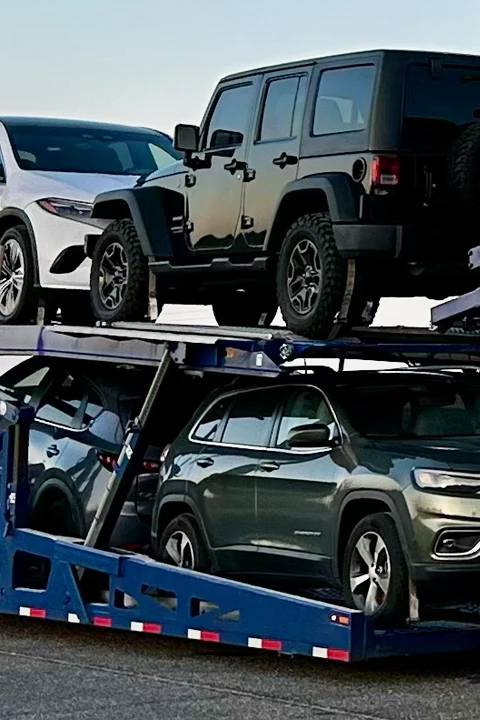
- Open Transport: The most popular and affordable option, with carriers running the I-87 and I-90 corridors and the New York-to-Florida snowbird lane almost daily.
- Enclosed Transport: A favorite for luxury and collector vehicles in Manhattan, Long Island, and Westchester, and for protecting paint and undercarriages from road salt during New York winters.
- Door-to-Door Delivery: Carriers get as close to your address as truck access allows; in dense areas like Manhattan and Brooklyn we often arrange a nearby meeting point large car haulers can reach.
- Expedited Shipping: Faster carrier assignment for time-sensitive moves, including corporate relocations and military PCS orders.
Dispatch Dudes arranges car shipping across the entire state, from New York City and Long Island (Nassau and Suffolk) up through Westchester and the Hudson Valley to Albany, west along the Thruway to Syracuse, Rochester, and Buffalo, and into the Southern Tier and North Country. Whether you are in a Manhattan high-rise, a Long Island suburb, or upstate near the Finger Lakes, we match you with carriers that run your route regularly.
Shipping a Vehicle To or From New York
Shipping a Car To New York
New York pairs one of the densest urban markets in the country with long upstate distances. New York City to Buffalo runs about 370 miles on I-90 (the Thruway), NYC to Albany roughly 150 miles up I-87, and the metro connects to New England and the Mid-Atlantic via I-95, I-84, and I-81. That mix of tight city logistics and long interstate hauls means carrier availability and pricing vary a lot between downstate and upstate lanes.
New York City’s enormous job market — spanning Wall Street, tech, media, and healthcare — attracts professionals from across the country and around the world. Spring is the peak inbound season as snowbirds return from their winter stays in Florida, Arizona, and the Carolinas, with vehicles moving north on I-95 between March and May. Students heading back to New York for the summer and fall also contribute to inbound volume. I-95 north and I-87 — the New York State Thruway — are the state’s main inbound arteries.
Military relocations under PCS (Permanent Change of Station) orders are a steady part of New York auto transport, with major installations including the U.S. Military Academy at West Point, Fort Drum near Watertown (home of the 10th Mountain Division), Fort Hamilton in Brooklyn, and Hancock Field and Niagara Falls Air Reserve Station upstate. We understand base-access requirements and PCS report-by dates and schedule pickup or delivery to match.
Shipping a Car From New York
Outbound shipments surge every fall as snowbirds head south for the winter, making October through December one of the highest-volume periods for southbound East Coast carriers. Beyond the seasonal migration, New York’s cost of living continues to push residents to relocate to Florida, Texas, and North Carolina. This keeps outbound routes active year-round. I-95 south toward Florida and I-78 west toward Pennsylvania are the most common departure routes from the metro area.
New York is also a major hub for dealers and auction buyers. Manheim and Copart operate auction sites across the state, from the Hudson Valley and Newburgh area to Albany and Western New York, while the Port of New York and New Jersey handles heavy vehicle import and export volume. We move single units and full inventory loads to and from these auctions and ports, coordinating gate releases and buyer-number documentation so vehicles clear quickly.
Popular Car Shipping Routes To and From New York
Top outbound routes:
- New York to Florida — the defining snowbird route, one of the most active corridors in the eastern US each fall
- New York to Texas — corporate relocations and lifestyle moves to Dallas and Houston keep this long-haul route busy
- New York to California — coast-to-coast moves for entertainment, tech, and finance professionals
Top inbound routes
- Florida to New York — the spring snowbird return wave, one of the most predictable high-volume lanes in the country
- California to New York — coast-to-coast traffic from the entertainment and finance industry moves
- Midwest and Illinois to New York — Chicago to New York is a consistent corporate and student relocation route
New York-specific shipping considerations: A few realities shape how vehicles move here. Upstate winters bring heavy snow and road salt, especially the lake-effect belts around Buffalo and Syracuse, so many owners of luxury and collector cars choose enclosed transport from late fall through early spring. New York is also a classic snowbird origin, with large outbound volume to Florida each winter and the return north in spring, which tightens capacity and rates on those lanes. And unlike many states, New York requires an annual safety and emissions inspection, so build that into your timeline once a vehicle arrives.

What Impacts Car Shipping Costs in New York?
Seasonality
New York's snowbird cycle is the biggest pricing driver on East Coast routes. Fall southbound, and spring northbound rates tend to be higher — booking early is the best way to manage this.
Distance
New York to Florida is 1,200+ miles. New York to California is nearly 2,800 miles. Longer routes cost more and fluctuate with demand.
NYC access complexity
Large transport trucks have limited access in Manhattan and some Brooklyn neighborhoods. This can affect pickup and delivery logistics.
Winter weather
Northeast snowstorms between December and March can affect scheduling on I-95 and other main corridors.
Vehicle type
Larger vehicles, such as SUVs and trucks, take up more trailer space and are priced accordingly.
How Our Car Shipping Process Works
- Request a quote: Share your origin, destination, vehicle type, and preferred dates.
- Carrier assignment: We match you with an insured carrier from our network that services your New York route.
- Pickup inspection: The driver documents your vehicle’s condition on a Bill of Lading prior to transport. Keep your copy.
- Delivery and final check: Inspect the vehicle at delivery against the original report before signing off.
The New York to Florida route takes 3 to 5 days. The trip from New York to Texas takes 5 to 7 days. A cross-country trip to California typically takes 7 to 10 days. Winter storms along the Northeast corridor, NYC traffic, and peak-season demand can all affect these windows. We communicate proactively when conditions change.
As a licensed auto-transport broker, Dispatch Dudes (Kats & Co LLC) is registered with the Federal Motor Carrier Safety Administration (FMCSA) under USDOT# 3446819 and MC# 1120978. We verify every carrier’s active operating authority, safety rating, and cargo-insurance certificate before assigning your vehicle, and we post loads to Central Dispatch — the industry’s primary carrier load board — to source the right truck for your route. Standard open carriers haul 7 to 10 vehicles on a multi-car trailer, while enclosed shipments often move on smaller 2-to-6-car trailers with lift-gate loading and soft tie-downs for low-clearance vehicles. The Bill of Lading completed at pickup is your official condition report and the document used for any cargo-insurance claim.
Dispatch Dudes is a U.S.-based, FMCSA-licensed auto-transport broker (USDOT# 3446819, MC# 1120978) coordinating shipments nationwide including every major New York market. With 6+ years in business and a 4.9-star rating from 449 Google reviews, we pair you with vetted carriers that all carry verified, active cargo insurance. Reach our team at 754-201-8264 for updates from pickup to delivery.
Why Choose Dispatch Dudes for Car Shipping in New York?
Fully insured carriers
Cargo insurance verified before your vehicle is ever loaded
Nationwide carrier network
Coverage across all major New York routes, with flexibility during busy seasons
Real-time updates
Regular communication so you're never left wondering
Dedicated support
Responsive team, especially during New York's high-volume shipping seasons
Competitive pricing
Honest rates without surprise fees
Registering a Vehicle You Ship Into New York
New York runs one of the more demanding inspection regimes in the country, and it is worth knowing before your vehicle arrives. Every vehicle registered in New York State must be inspected at least every 12 months, and that inspection covers both safety and emissions in a single visit at a DMV-licensed station. There is no county carve-out as there is in Ohio, Georgia or Illinois — the requirement is statewide, from Manhattan to the Adirondacks, though the emissions portion differs between the New York City metropolitan area and the rest of the state. For a vehicle shipped in from elsewhere, the practical point is that an out-of-state inspection sticker carries no weight in New York: the car will need a New York inspection regardless of how recently it was tested somewhere else, so it is worth identifying a licensed station near your new address before the vehicle lands.
Frequently Asked Questions About Car Shipping in New York
Yes. We service all five boroughs, though large transport trucks have access limitations in parts of Manhattan and dense neighborhoods. In those cases, pickup or drop-off is coordinated at a nearby accessible location — we arrange this in advance.
Book 2 to 3 weeks out, ideally in September. Southbound carrier availability tightens quickly as October approaches. Booking early also helps lock in better rates before peak-season pricing kicks in.
Yes, open transport is used year-round, including through Northeast winters. Carriers are experienced with these conditions. If you’re shipping a high-value or pristine vehicle, enclosed transport is worth considering during the colder months.
Yes. All carriers in our network maintain active cargo insurance. The Bill of Lading documents your vehicle’s condition before transport and serves as the reference point for any claims at delivery.
Yes. Non-running vehicles can be transported. Just let us know upfront so we can assign a carrier with the right loading equipment. There may be a modest additional cost.
Intrastate New York lanes such as NYC to Buffalo (about 370 miles on I-90) or NYC to Albany typically complete in 1 to 2 days once a carrier is assigned. Longer or cross-country hauls run 2 to 7 days depending on distance, season, and demand.
Yes. New York requires an annual safety inspection and, in most counties, an emissions inspection. A vehicle shipped into New York can be driven home, but you will need it inspected and registered with the New York DMV within the required window.
Yes. We regularly move single units and full inventory loads to and from Manheim and Copart auction sites and dealerships across New York, coordinating gate releases and buyer-number documentation so vehicles clear quickly.
We arrange transport statewide, including New York City, Long Island, Yonkers, Albany, Syracuse, Rochester, and Buffalo, along corridors including I-87, I-90, I-95, I-81, and I-84. Popular lanes include New York to Florida, New York to California, and New York to Texas.
Yes. Every vehicle registered in New York State must be inspected at least every 12 months, covering both safety and emissions in one visit at a DMV-licensed station. An out-of-state inspection sticker carries no weight — the vehicle will need a New York inspection regardless of how recently it was tested elsewhere.
The inspection requirement itself is statewide, unlike Ohio or Georgia where testing is limited to particular counties. The emissions portion of the test differs between the New York City metropolitan area and the rest of the state, but every registered vehicle needs the annual inspection wherever it is garaged.
THREE Easy steps
How do I book with the Dispatch Dudes?
Step 1
Get A Quote
Give us a call, email, or request a quote below to get started with the most premium auto-shipments.
Step 2
Confirm Your Booking
Verify your pick-up & drop-off dates, then place your order.
Step 3
Get Your Car Shipped
We can have your car scheduled for shipment in as little as 24 hours.
Get a Car Shipping Quote in New York
Whether you’re heading south for the winter, returning in spring, or relocating from New York to any destination in the country, Dispatch Dudes is ready to help. We serve New York City, Buffalo, Rochester, Albany, Syracuse, and communities across the entire state.
Get your free, no-obligation quote today or call to speak with a New York auto transport specialist!